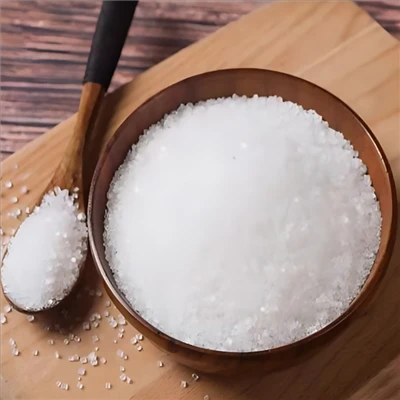
In the routine operation and maintenance of water treatment plants, water supply networks and heat exchangers, the accumulation of scale and rust leads to a sharp decline in heat exchange efficiency, a reduction in the flow cross-section of pipelines, and fluctuations in outlet water parameters.
To solve this problem efficiently, many water utilities use solid oxalic acid for chemical cleaning. Yet when faced with products of different purities on the market, why do professional tender documents (such as the recent tender of Mykolaiv Water Utility) explicitly require an oxalic acid purity of no less than 99.5%, which falls within the ≥99% high-purity range?
This is not simply a matter of "the higher the purity, the better". It is a hard technical threshold that concerns both equipment safety and cleaning effectiveness.
1. Three Descaling Mechanisms of High-Purity Oxalic Acid
Solid oxalic acid with a purity of ≥99% works through three synergistic mechanisms during cleaning, and none of them can be dispensed with:
- Dissolution: the hydrogen ions released by oxalic acid rapidly dissolve calcium carbonate scale and rust.
- Peeling: the carbon dioxide generated during the reaction uses bubble buoyancy to physically detach stubborn scale layers from the metal surface.
- Anti-reflash rusting: oxalate ions form a stable soluble complex with iron ions, "sealing" the iron ions in solution and effectively preventing the cleaned metal surface from rusting again.
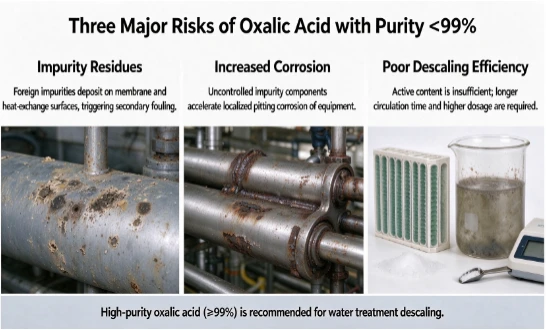
2. Three Critical Hazards of Insufficient Purity (<99%)
If low-purity oxalic acid is used to save cost, the "protection mechanisms" described above will instantly turn into "destruction mechanisms". Impurities introduce irreversible damage:
- Sulfate ions (SO₄²⁻): they combine with calcium ions in the water, causing secondary calcium sulfate scaling and nullifying the entire cleaning effort.
- Chloride ions (Cl⁻): the "killer" of stainless steel. They cause pitting corrosion, i.e. perforation, and directly shorten the service life of expensive heat exchange equipment.
- Ash deposition: ash left after the combustion of impurities deposits in pumps, valves and filter media, causing mechanical failures.
3. Optimal Preparation Standard: 3%–5% Working Solution
Only solid oxalic acid with a purity of 99% or above allows a 3%–5% cleaning working solution to be prepared safely without introducing impurity ions, based on an oxalic acid molecular weight of 90.0–90.05 g/mol and a density of 1.65 g/cm³,A solution at this concentration is sufficient to complex and remove scale and rust, while fully meeting the dual requirements of efficient descaling and substrate protection.
Note: the above is a general reference ratio. Where equipment materials (carbon steel, 304 or 316L stainless steel), scale types or cleaning water temperatures differ, a corrosion inhibitor should be added and the scheme verified against actual site conditions.
4. Cost and Risk Comparison
- Low-purity oxalic acid (<99%) is nominally 10%–15% cheaper, but after cleaning it readily leaves impurities behind and pipes and metal surfaces are prone to rust again. The equipment risk is high: chloride ions cause pitting and perforation of stainless steel, and sulfate ions trigger secondary scaling, so the hidden costs of subsequent equipment repair and downtime are very high.
- Compliant high-purity oxalic acid (≥99.5%) has a slightly higher purchase cost, yet it delivers stable cleaning performance and thorough descaling and inhibits re-rusting through complexation. Its harmful impurity content is extremely low and it is friendly to stainless steel substrates, so equipment damage risk is low; it extends equipment service life and reduces the probability of downtime, giving a better overall cost in the long term.
This is precisely why we always adhere to the ≥99% purity standard when supplying oxalic acid to water treatment customers in Ukraine and Europe.
Disclaimer: This content is for general chemical knowledge reference only and shall not be regarded as technical guidance or usage advice. Material performance varies with product grade, operating conditions and formulation. Always verify against the product MSDS and manufacturer's test data before field application.
References:
1.Chemical Disinfectants: https://www.cdc.gov/infection-control/hcp/disinfection-sterilization/chemical-disinfectants.html
2.Infection Control: https://www.chp.gov.hk/en/resources/346/index.html
3.ChemicalBook: https://www.chemicalbook.com