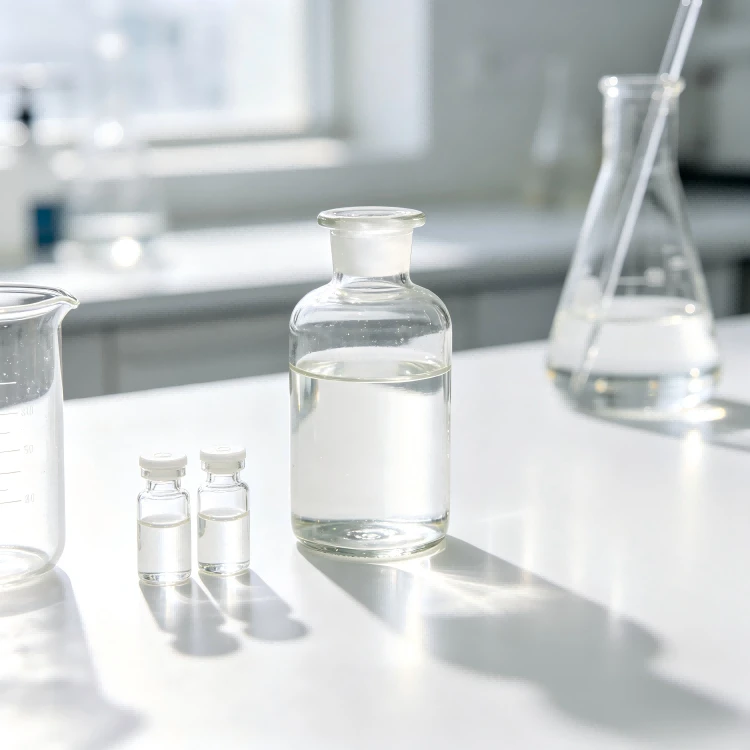

Shanghai Dingwujin Chemical Co., Ltd. (7DCHEM) is a reliable supplier of isopropyl alcohol in China. We cooperate with qualified Chinese factories and focus on chemical distribution to Central Europe, Eastern Europe and Ukraine. We welcome inquiries for wholesale and custom-spec isopropyl alcohol manufactured in China.
Isopropyl Alcohol
Introduction
Characteristics
| Molar Weight | 60.1 g/mol |
| Melting Point | -89 °C |
| Boiling Point | 81.1°C to 83.3°C |
| Flash Point | 12.0°C |
| Density | 0.786 g/cm3 |
| Forms | Liquid (clear), Colorless |
Product Grades
Industrial Grade
Premium grade ≥99.7% or ≥99.9%, qualified grade ≥99.5%. Used in coatings, inks, antifreeze, general cleaning, etc.
Pharmaceutical Grade
Restricted toxic impurities (methanol, heavy metals) and microbial limits. Used in drug production, medical device disinfection, and cosmetic raw materials.
Reagent Grade
Used in laboratory analysis, research, and teaching, with strict impurity control.
- GR (Guaranteed Reagent): ≥99.8%, for precision analysis
- AR (Analytical Reagent): ≥99.5%, most commonly used grade
- HPLC (Chromatographic Grade): Limited UV absorption and carbonyl compounds, for liquid chromatography
Electronic Grade
Used in semiconductors, display panels, with core control over metal ions and particulates.
- Purity: Basic grade ≥99.9%, high-end (G4/G5) ≥99.99%
- Metal Ions: Controlled at ppt/ppb levels, single ion content <100 ppt
- Particulates: Submicron filtration, <1 particle/mL
- Grading: EL/MOS/G1~G5 grades, corresponding to different process nodes
Standard stock items are of industrial grade. For special grade orders, please contact us for complete documentation.
Uses and Applications
new energy vehicle
- Disinfectant
- Ink, Toner and Colourant
- Fungicide
- Sanitizers
- Anti-freeze
- Lacquers
- Ceramics
- Cleaning Products
- Adhesives and Sealants
- Solvents
- Pharmaceuticals
- Cosmetic Products
metal processing
- Pharma
- Energy Services
- Polymers
- CASE & Construction
- Beauty & Personal Care
- Cleaning
- Food & Nutrition
- Agriculture
- Lubricants
- Rubber
- Water Treatment
IPA Used in the Electronic Industry
IPA is used as a high-purity solvent for surface degreasing and dehydration cleaning of semiconductors, integrated circuits, and PCBs.


Isopropanol Used in the Chemical Manufacturing
Isopropanol is mainly used in the production of bulk and fine chemicals such as acetone, hydrogen peroxide, methyl isobutyl ketone (MIBK), and isopropylamine.
Propanol Used in the Coating Industry
Propanol is an excellent solvent for nitrocellulose, rubber, and resins. It is used to adjust viscosity and accelerate drying, and is widely applied in the production of alcohol-soluble inks and environmentally friendly coatings.


1-Methylethanol Used in the Pharmaceutical Industry
- Medical Disinfectant: 1-Methylethanol at a concentration of 70%–75% exhibits the best bactericidal efficacy and is commonly used for skin disinfection (e.g., pre-injection) and surface disinfection of medical instruments (e.g., thermometers, surgical tools).
- Pharmaceutical Intermediates: It is used in the synthesis of certain drugs (e.g., antibiotics, vitamins) or as a solvent in production processes.
1-Methylethyl Alcohol Used in the Cosmetic Industry
1-Methylethyl alcohol is used as a solvent or carrier in cosmetics, perfumes, hair sprays, and hand sanitizers, helping ingredients disperse evenly and dry quickly.


2-Hydroxypropane Used in the Energy Industry
Isopropyl alcohol can be added in small amounts to gasoline as a dehydrating agent or blending component to improve combustion performance.
2-Propanol Used in the Laboratory
In biological, chemical, and pharmaceutical laboratories, 2-propanol is widely used as a solvent, reaction medium, or cleaning agent due to its excellent chemical properties, facilitating smooth experiments and accurate results.

SECTION 1: Identification of the substance/mixture and of the company/undertaking
Product identifier
- Product name: Isopropyl alcohol
- CBnumber: CB8854102
- CAS: 67-63-0
- EINECS Number: 200-661-7
- Synonyms: IPA,Isopropyl Alcohol
Relevant identified uses of the substance or mixture and uses advised against
- Relevant identified uses: For R&D use only. Not for medicinal, household or other use.
- Uses advised against: none
SECTION 2: Hazards identification
GHS Label elements, including precautionary statements
Symbol(GHS)

Signal wordDanger
Precautionary statements
- P210 Keep away from heat/sparks/open flames/hot surfaces. - No smoking.
- P261 Avoid breathing dust/fume/gas/mist/vapours/spray.
- P280 Wear protective gloves/protective clothing/eye protection/face protection.
- P303+P361+P353 IF ON SKIN (or hair): Remove/Take off Immediately all contaminated clothing. Rinse SKIN with water/shower.
- P305+P351+P338 IF IN EYES: Rinse cautiously with water for several minutes. Remove contact lenses, if present and easy to do. Continuerinsing.
- P337+P313 IF eye irritation persists: Get medical advice/attention.
- P370+P378 In case of fire: Use … for extinction.
- P403+P235 Store in a well-ventilated place. Keep cool.
- P405 Store locked up.
Hazard statements
- H225 Highly Flammable liquid and vapour
- H319 Causes serious eye irritation
- H336 May cause drowsiness or dizziness
SECTION 3: Composition/information on ingredients
Substance
- Product name: Isopropyl alcohol
- Synonyms: IPA,Isopropyl Alcohol
- CAS: 67-63-0
- EC number: 200-661-7
- MF: C3H8O
- MW: 60.1
SECTION 4: First aid measures
Description of first aid measures
General advice
Show this material safety data sheet to the doctor in attendance.
If inhaled
After inhalation: fresh air. Call in physician.
In case of skin contact
In case of skin contact: Take off immediately all contaminated clothing. Rinse skin with water/ shower.
In case of eye contact
After eye contact: rinse out with plenty of water. Call in ophthalmologist. Remove contact lenses.
If swallowed
After swallowing: immediately make victim drink water (two glasses at most). Consult a physician.
Most important symptoms and effects, both acute and delayed
The most important known symptoms and effects are described in the labelling (see section 2.2) and/or in section 11
Indication of any immediate medical attention and special treatment needed
No data available
SECTION 5: Firefighting measures
Extinguishing media
Suitable extinguishing media
Carbon dioxide (CO2) Foam Dry powder
Unsuitable extinguishing media
For this substance/mixture no limitations of extinguishing agents are given.
Special hazards arising from the substance or mixture
Carbon oxides Combustible.
Pay attention to flashback.
Vapors are heavier than air and may spread along floors.
Development of hazardous combustion gases or vapours possible in the event of fire. Forms explosive mixtures with air at ambient temperatures.
Advice for firefighters
In the event of fire, wear self-contained breathing apparatus.
Further information
Remove container from danger zone and cool with water. Prevent fire extinguishing water from contaminating surface water or the ground water system.
SECTION 6: Accidental release measures
Personal precautions, protective equipment and emergency procedures
Advice for non-emergency personnel: Do not breathe vapors, aerosols. Avoid substance contact. Ensure adequate ventilation. Keep away from heat and sources of ignition.
Evacuate the danger area, observe emergency procedures, consult an expert. For personal protection see section 8.
Environmental precautions
Do not let product enter drains. Risk of explosion.
Methods and materials for containment and cleaning up
Cover drains. Collect, bind, and pump off spills. Observe possible material restrictions (see sections 7 and 10). Take up with liquid-absorbent material (e.g. Chemizorb? ). Dispose of properly. Clean up affected area.
Reference to other sections
For disposal see section 13.
SECTION 7: Handling and storage
Precautions for safe handling
Advice on safe handling
Avoid generation of vapours/aerosols.
Advice on protection against fire and explosion
Keep away from open flames, hot surfaces and sources of ignition.Take precautionary measures against static discharge.
Hygiene measures
Change contaminated clothing. Wash hands after working with substance. For precautions see section 2.2.
Conditions for safe storage, including any incompatibilities
Storage conditions
Keep container tightly closed in a dry and well-ventilated place. Keep away from heat and sources of ignition.
Handle and store under inert gas. Hygroscopic.
Specific end use(s)
Apart from the uses mentioned in section 1.2 no other specific uses are stipulated
SECTION 8: Exposure controls/personal protection
control parameter
Hazard composition and occupational exposure limits
Does not contain substances with occupational exposure limits.
Exposure controls
Personal protective equipment
Eye/face protection
Use equipment for eye protection tested and approved under appropriate government standards such as NIOSH (US) or EN 166(EU). Safety glasses
Skin protection
This recommendation applies only to the product stated in the safety data sheet, supplied by us and for the designated use. When dissolving in or mixing with other substances and under conditions deviating from those stated in EN374 please contact the supplier of CE-approved gloves (e.g. KCL GmbH, D-36124 Eichenzell, Internet: www.kcl.de).
Full contact
Material: Nitrile rubber
Minimum layer thickness: 0,4 mm Break through time: 480 min
Material tested:Camatril? (KCL 730 / Aldrich Z677442, Size M)
This recommendation applies only to the product stated in the safety data sheet, supplied by us and for the designated use. When dissolving in or mixing with other substances and under conditions deviating from those stated in EN374 please contact the supplier of CE-approved gloves (e.g. KCL GmbH, D-36124 Eichenzell, Internet: www.kcl.de).
Splash contact Material: Chloroprene
Minimum layer thickness: 0,65 mm Break through time: 120 min Material tested:KCL 720 Camapren?
Body Protection
Flame retardant antistatic protective clothing.
Respiratory protection
Recommended Filter type: Filter A (acc. to DIN 3181) for vapours of organic compounds
The entrepeneur has to ensure that maintenance, cleaning and testing of respiratory protective devices are carried out according to the instructions of the producer.
These measures have to be properly documented.
Control of environmental exposure
Do not let product enter drains. Risk of explosion.
Exposure limits
TLV-TWA 980 mg/m3 (400 ppm); STEL 1225 mg/m3 (500 ppm) (ACGIH); IDLH 12,000 ppm (NIOSH).
SECTION 9: Physical and chemical properties
Information on basic physicochemical properties
- Appearancecolorless liquid
- Odouralcohol-like
- Odour Threshold1 ppm
- pHat 20 °C neutral
- Melting point/freezing pointMelting point/range: -89,5 °C
- Initial boiling point and boiling range82 °C
- Flash point12,0 °C - closed cup
- Evaporation rate3,0
- Flammability (solid, gas)No data available
- Upper/lower flammability or explosive limitsUpper explosion limit: 13,4 %(V) Lower explosion limit: 2 %(V)
- Vapour pressure43 hPa at 20 °C
- Vapour density2,07
- Relative density0,785 g/mL at 25 °C
- Water solubilityat 20 °C soluble
- Partition coefficient: n-octanol/waterlog Pow: 0,05 - Bioaccumulation is not expected.
- Autoignition temperature425,0 °C
- Decomposition temperatureDistillable in an undecomposed state at normal pressure.
- ViscosityViscosity, kinematic: No data available Viscosity, dynamic: 2,2 mPa.s at 20 °C
- Explosive propertiesNo data available
- Oxidizing propertiesNo data available
- λmaxλ: 260 nm Amax: 0.02
- λ: 280 nm Amax: 0.01
Other safety information
Minimum ignition energy
0,65 mJ
Conductivity < 0,1 μS/cm
Surface tension 20,8 mN/m at 25,0 °C
Relative vapor density2,07
SECTION 10: Stability and reactivity
Reactivity
Vapors may form explosive mixture with air.
Chemical stability
Reacts with air to form peroxides.
The product is chemically stable under standard ambient conditions (room temperature) .
Possibility of hazardous reactions
No data available
Conditions to avoid
Warming.
Incompatible materials
Acid anhydrides, Aluminum, Halogenated compounds, Acids, Strong oxidizing agents
Hazardous decomposition products
In the event of fire: see section 5
SECTION 11: Toxicological information
Information on toxicological effects
Acute toxicity
LD50 Oral - Rat - 5.840 mg/kg
(OECD Test Guideline 401)
LC50 Inhalation - Rat - male and female - 4 h - 37,5 mg/l (OECD Test Guideline 403)
LD50 Dermal - Rabbit - 12.800 mg/kg Remarks:
(RTECS)
Skin corrosion/irritation
Skin - Rabbit
Result: No skin irritation - 4 h (OECD Test Guideline 404)
Serious eye damage/eye irritation
Eyes - Rabbit Result: Eye irritation
(OECD Test Guideline 405)
(Regulation (EC) No 1272/2008, Annex VI)
Respiratory or skin sensitization
Buehler Test - Guinea pig Result: negative
(OECD Test Guideline 406)
Germ cell mutagenicity
Ames test
Salmonella typhimurium Result: negative
In vitro mammalian cell gene mutation test Chinese hamster ovary cells
Result: negative
OECD Test Guideline 474
Mouse - male and female - Bone marrow
Result: negative
Carcinogenicity
This product is or contains a component that is not classifiable as to its carcinogenicity based on its IARC, ACGIH, NTP, or EPA classification.
IARC: No ingredient of this product present at levels greater than or equal to 0.1% is identified as probable, possible or confirmed human carcinogen by IARC.
Reproductive toxicity
No data available
Specific target organ toxicity - single exposure
Inhalation, Oral - May cause drowsiness or dizziness. - Central nervous system Remarks:
Classified according to Regulation (EU) 1272/2008, Annex VI (Table 3.1/3.2) Acute inhalation toxicity - Central nervous system
Specific target organ toxicity - repeated exposure
No data available
Aspiration hazard
No data available
Toxicity
LD50 orally in rats: 5.8 g/kg (Smyth, Carpenter)
SECTION 12: Ecological information
Toxicity
Toxicity to fish
flow-through test LC50 - Pimephales promelas (fathead minnow) - 9.640 mg/l - 96 h
Toxicity to daphnia and other aquatic invertebrates
(OECD Test Guideline 203)
EC50 - Daphnia magna (Water flea) - 13.299 mg/l - 48 h Remarks: (IUCLID)
Toxicity to algae
IC50 - Desmodesmus subspicatus (green algae) - > 1.000 mg/l - 72 h
Remarks: (IUCLID)
Toxicity to bacteria
EC5 - Pseudomonas putida - 1.050 mg/l - 16 h
Remarks: (Lit.)
Persistence and degradability
Biodegradability aerobic - Exposure time 5 d
Result: 53 % - Readily biodegradable. (Directive 67/548/EEC, Annex V, C.6)
Theoretical oxygen demand
2.400 mg/g Remarks: (Lit.)
Ratio BOD/ThBOD 49 %
Remarks: (IUCLID)
Bioaccumulative potential
No bioaccumulation is to be expected (log Pow <= 4).
Mobility in soil
No data available
Results of PBT and vPvB assessment
This substance/mixture contains no components considered to be either persistent, bioaccumulative and toxic (PBT), or very persistent and very bioaccumulative (vPvB) at levels of 0.1% or higher.
Other adverse effects
No data available
SECTION 13: Disposal considerations
Waste treatment methods
Product
See www.retrologistik.com for processes regarding the return of chemicals and containers, or contact us there if you have further questions.
Incompatibilities
Incompatible with oxidizing agents such as hydrogen peroxide and nitric acid, which cause decomposition. Isopropyl alcohol may be salted out from aqueous mixtures by the addition of sodium chloride, sodium sulfate, and other salts, or by the addition of sodium hydroxide.
SECTION 14: Transport information
UN number
ADR/RID: 1219 IMDG: 1219
UN proper shipping name
ADR/RID: ISOPROPANOL IMDG: ISOPROPANOL IATA: Isopropanol
Transport hazard class(es)
ADR/RID: 3 IMDG: 3 IATA: 3
Packaging group
ADR/RID: II IMDG: II IATA: II
Environmental hazards
ADR/RID: no IMDG Marine pollutant: no IATA: no
Special precautions for user
No data available
SECTION 15: Regulatory information
Safety, health and environmental regulations/legislation specific for the substance or mixture
Regulations on the Safety Management of Hazardous Chemicals
China Catalog of Hazardous chemicals 2015:Listed. website: https://www.mem.gov.cn/
Measures for Environmental Management of New Chemical Substances
Chinese Chemical Inventory of Existing Chemical Substances (China IECSC):Listed. website: https://www.mee.gov.cn/
EC Inventory:Listed.
European Inventory of Existing Commercial Chemical Substances (EINECS):Listed. website: https://echa.europa.eu/
Korea Existing Chemicals List (KECL):Listed. website: http://ncis.nier.go.kr
New Zealand Inventory of Chemicals (NZIoC):Listed. website: https://www.epa.govt.nz/
Philippines Inventory of Chemicals and Chemical Substances (PICCS):Listed. website: https://emb.gov.ph/
United States Toxic Substances Control Act (TSCA) Inventory:Listed. website: https://www.epa.gov/
Vietnam National Chemical Inventory:Listed. website: https://chemicaldata.gov.vn/
SECTION 16: Other information
Abbreviations and acronyms
ADR: European Agreement concerning the International Carriage of Dangerous Goods by Road
CAS: Chemical Abstracts Service
EC50: Effective Concentration 50%
IATA: International Air Transportation Association
IMDG: International Maritime Dangerous Goods
LC50: Lethal Concentration 50%
LD50: Lethal Dose 50%
RID: Regulation concerning the International Carriage of Dangerous Goods by Rail
STEL: Short term exposure limit
TWA: Time Weighted Average
References
【1】CAMEO Chemicals, website: http://cameochemicals.noaa.gov/search/simple
【2】ChemIDplus, website: http://chem.sis.nlm.nih.gov/chemidplus/chemidlite.jsp
【3】ECHA - European Chemicals Agency, website: https://echa.europa.eu/
【4】eChemPortal - The Global Portal to Information on Chemical Substances by OECD, website: http://www.echemportal.org/echemportal/index?pageID=0&request_locale=en
【5】ERG - Emergency Response Guidebook by U.S. Department of Transportation, website: http://www.phmsa.dot.gov/hazmat/library/erg
【6】Germany GESTIS-database on hazard substance, website: http://www.dguv.de/ifa/gestis/gestis-stoffdatenbank/index-2.jsp
【7】HSDB - Hazardous Substances Data Bank, website: https://toxnet.nlm.nih.gov/newtoxnet/hsdb.htm
【8】IARC - International Agency for Research on Cancer, website: http://www.iarc.fr/
【9】IPCS - The International Chemical Safety Cards (ICSC), website: http://www.ilo.org/dyn/icsc/showcard.home
【10】Sigma-Aldrich, website: https://www.sigmaaldrich.com/
Other Information
Use of alcoholic beverages enhances the harmful effect.
Disclaimer:
The information in this MSDS is only applicable to the specified product, unless otherwise specified, it is not applicable to the mixture of this product and other substances. This MSDS only provides information on the safety of the product for those who have received the appropriate professional training for the user of the product. Users of this MSDS must make independent judgments on the applicability of this SDS. The authors of this MSDS will not be held responsible for any harm caused by the use of this MSDS.