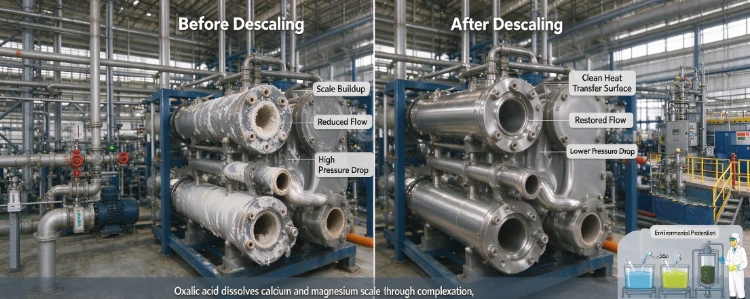
Heat exchangers, pipelines, reverse osmosis (RO) membranes, and filter beds in water treatment plants are all susceptible to scaling, which leads to reduced heat transfer efficiency, increased differential pressure, and higher chemical consumption. Oxalic acid is a commonly used acidic descaling agent; its environmental footprint depends entirely on how it is manufactured and how it is applied.
I. Descaling Mechanism
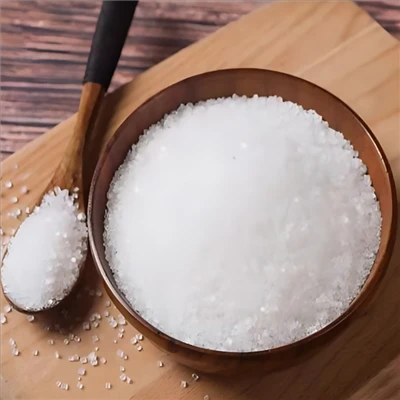
Oxalic acid (ethanedioic acid) is a white crystalline solid. It removes scale through three primary mechanisms: dissolving calcium carbonate and magnesium carbonate scales via acid reaction; reducing insoluble ferric iron (Fe³⁺) to soluble ferrous iron (Fe²⁺) for rust removal; and chelating metal ions to disintegrate the scale layer. Compared to hydrochloric or sulfuric acid, oxalic acid causes less over-corrosion of the metal substrate when used at appropriate concentrations. However, it is highly irritating and corrosive, with a minimum lethal dose for adults of 71 mg/kg. Special caution is required regarding aquatic environments. It must be stored in sealed containers in a cool, shaded place at temperatures not exceeding 40°C, and kept away from oxidizers and alkaline substances.
II. Selecting Environmentally Friendly Production Processes
The manufacturing process determines the inherent environmental profile of the product. The sodium formate method has been largely phased out. Starch or glucose oxidation methods require supporting nitric acid plants and entail significant pollution control burdens. In contrast, carbon monoxide coupling does not introduce sulfate radicals, and its methanol by-product can be reused, making it a cleaner alternative.
Environmental compliance in production focuses on four key areas: nitrogen oxides are absorbed and recovered as dilute nitric acid; drying and packaging exhaust gases are treated via cyclone separators and bag filters; fugitive emissions are controlled through negative-pressure enclosed conveying and Leak Detection and Repair (LDAR) programs; and mother liquor is recycled repeatedly-after decolorization and purification via resin, it is returned to the production cycle to achieve near-zero discharge. Waste lubricating oil is collected in dedicated tanks and handed over to qualified disposal facilities. Acid washing solutions typically contain 2% oxalic acid and must be handled in covered, enclosed systems.
III. Five Mandatory Requirements for Descaling in Water Plants
1.Identify Scale Type Before Chemical Selection
Oxalic acid excels at dissolving rust and metal oxide scales. However, it reacts with calcium ions to form sparingly soluble calcium oxalate, which can precipitate as white crystals that clog pipes and filter media. For pure carbonate scales, citric acid should be prioritized.
2.Strictly Control Concentration, Temperature, and Duration
Descaling efficacy is not directly proportional to concentration. In practice, 1%–5% is usually sufficient; excessive concentrations damage the base material and waste chemicals. Operating temperatures generally range from 20°C to 60°C. For plate heat exchangers, oxalic acid is often compounded with phosphoric acid at concentrations no higher than 4% and temperatures around 60°C. For RO membrane cleaning, a 2% oxalic acid solution at pH 2–4 is typically used under low pressure at ambient temperature, with approximately one hour per stage, following the guidelines in GB/T 23954-2009. Oxalic acid is strictly prohibited for use on aluminum, aluminum alloys, and marble. Corrosion inhibitors should be added where necessary. The procedure must follow a "water rinse → acid wash → water rinse → passivation" sequence, as the passivation film helps inhibit future fouling.
3.Uphold Drinking Water Safety Standards
Chemical treatment agents must not contaminate drinking water. The national standard GB/T 17218-2025, effective March 1, 2026, stipulates that specific substances introduced by treatment agents must generally not exceed 10% of the limits set in GB 5749. Article 2.7.1 of CJJ 58-2009 is mandatory, requiring that all chemicals possess valid production licenses, sanitary permits, certificates of conformity, and inspection reports, with batch-by-batch sampling inspections. After cleaning, equipment must be rinsed until the effluent pH approaches neutral and no residues remain. Pipelines and tanks must be flushed and disinfected in accordance with GB 50268-2008 until laboratory testing confirms compliance.
4.Ensure Personnel Protection and Observe Two Critical Prohibitions
Work areas must be well-ventilated. Operators must wear acid/alkali-resistant gloves, safety goggles, and protective clothing; direct skin contact with the chemical is strictly forbidden. Eyewash stations and clean water must be readily available. When preparing solutions, always add oxalic acid slowly into water-never the reverse. In case of skin contact, flush immediately with copious amounts of flowing water for at least 15 minutes; for eye contact, rinse for 10–15 minutes and seek immediate medical attention. Spills should be contained with sand or soil, absorbed, and neutralized with sodium bicarbonate.
Two Critical Prohibitions:
- Never mix oxalic acid with chlorine-containing disinfectants such as sodium hypochlorite; this combination releases toxic chlorine gas under acidic conditions.
- Never discharge waste solution into sinks, drains, or stormwater systems.
5.Manage Waste Liquid Through a Six-Step Protocol: Collection → Neutralization → Precipitation → Separation → Degradation → Compliance
Dose chemicals based on system volume and employ closed-loop circulation to minimize waste generation. Acidic and alkaline waste streams must be collected separately; direct neutralization within collection tanks is prohibited. The core treatment step is neutralization-precipitation: lime or sodium hydroxide is added to adjust pH, causing calcium ions to react with oxalate ions to form calcium oxalate precipitate-the most cost-effective removal method. Resulting sludge must be disposed of according to its solid waste classification. Residual organic matter is then degraded via advanced oxidation processes or through acclimated aerobic/anaerobic biological treatment. Final effluent must be adjusted to pH 6–9 before discharge.
In summary, environmental responsibility on the production side hinges on clean manufacturing processes and closed-loop pollution control; on the application side, it requires correct scale identification, precise parameter control, strict adherence to hygiene standards, and proper waste management. Environmentally responsible operations are, invariably, also the most economically efficient.