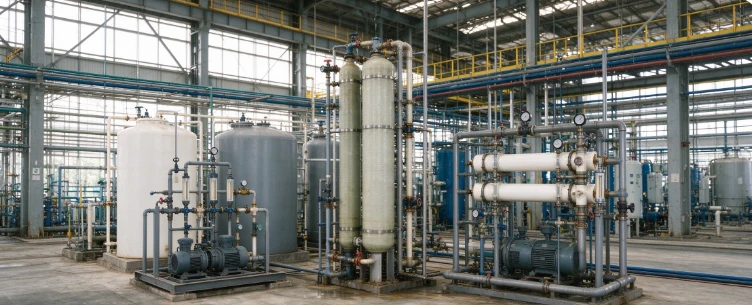
In the chemical water treatment system of power plants, anion exchange resins, reverse osmosis membranes and chemical dosing pipelines continuously accumulate silica scale and organic contaminants, which steadily reduce the exchange capacity of resins and the permeate flux of membranes. This leads to fluctuating boiler feed water quality, and in severe cases, forces unit load reduction or even emergency shutdown.
Caustic sodaserves as the core chemical for anion resin regeneration, pH adjustment and chemical cleaning of RO membranes. However, many purchasers hold a misunderstanding that diaphragm-process and ion-membrane liquid caustic soda are interchangeable as long as the concentration meets the standard. Nevertheless, power plant tenders in Ukraine list the ion-membrane manufacturing process and impurity limits as mandatory requirements. Behind this lies the selection logic for ensuring the long-term stable operation of the whole chemical water system.
1. The ion-membrane process is critical for impurity control of liquid caustic soda
- Purchasers often only focus on NaOH concentration and overlook the baseline difference in impurities brought by different production processes. The diaphragm process inherently comes with accompanying impurities such as sodium chloride, iron salts and carbonates. Even if the finished product reaches 44% concentration, the background impurity level remains relatively high. Ion-membrane electrolysis adopts a selective ion membrane to separate the products of the anode and cathode, inhibiting impurity generation at the source. This is the fundamental reason why power stations specify ion-membrane caustic soda.
- 44% ion-membrane liquid caustic soda performs multiple functions within the system: its highly active hydroxide ions displace silicate ions and humic acid adsorbed by resins to restore resin exchange capacity; under alkaline conditions, it hydrolyzes and loosens silica scale and organic matter attached to the membrane surface for easy flushing and removal; it stabilizes the pH of the system and inhibits the precipitation of metal ion hydrolysates to avoid secondary fouling and deposition.
2. Losses caused by impurity accumulation
Hazards from impurities are cumulative and do not trigger immediate failures: chloride ions continuously corrode reverse osmosis composite membranes, stainless steel pipelines and membrane housings, inducing pitting corrosion and perforation and resulting in irreversible scrapping of membrane elements; carbonates precipitate under alkaline working conditions, blocking resin pores and membrane surfaces and shortening the chemical cleaning cycle; iron ions cause permanent iron poisoning of anion resins and continuously impair exchange capacity, while forming iron oxide coatings on membrane surfaces that drag down permeate flux.
3. Significance of the dilution concentration range
44% is the stock concentration and is too high for direct membrane cleaning or resin regeneration; on-site dilution with water is mandatory. Qualified 44% ion-membrane liquid caustic soda (mass fraction of NaOH ≥44.0%, sodium carbonate ≤0.8%, sodium chloride ≤3.8%, ferric oxide ≤0.02%) is diluted on site to a mass fraction of 0.5%–2% for resin regeneration and alkaline cleaning of RO membranes. This concentration range balances regeneration efficiency and membrane tolerance limits: insufficient concentration leads to incomplete regeneration and poor silica removal; excessive concentration accelerates hydrolytic aging of the polymer functional layer of reverse osmosis membranes.
4. Core risks for long-term continuous operation of power plants
If only the unit price per ton is compared, the overall cost will be underestimated. Diaphragm-process liquid caustic soda has a lower unit price, yet it brings problems including frequent resin poisoning, rapid flux decay of membranes, higher cleaning frequency and pipeline corrosion. Coupled with losses from unit shutdowns, the comprehensive operation and maintenance cost is higher. Qualified 44% ion-membrane liquid caustic soda has a slightly higher procurement cost, but its impurity indicators are controllable. It can effectively protect resins and membrane elements, maintain a stable cleaning cycle and reduce unplanned shutdowns, making it more suitable for power plant scenarios with continuous operation.
This is also the core reason why we adhere to the ion-membrane process and lock in a full set of internal impurity control indicators for supply to Ukrainian energy projects, complying with the tender technical requirements of power stations such as Centrenergo of Ukraine.
Disclaimer: This article is for chemical knowledge popularization only and does not constitute a technical scheme or usage recommendation. Material performance is subject to product grade and on-site working conditions. Please verify against the MSDS and test data from equipment manufacturers before formal application.