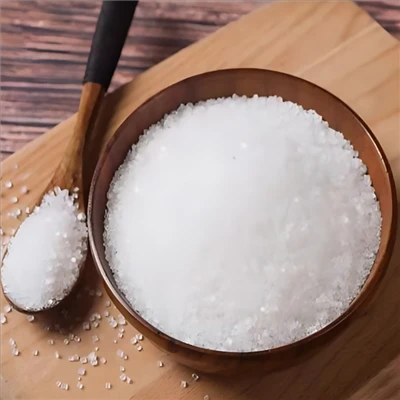
In acid mine drainage (AMD) treatment projects, field engineers often encounter a counterintuitive failure: the purchased soda ash (sodium carbonate) reaches a purity of 99%, and its main chemical component meets the premium grade requirements of the national standard. However, its physical properties fail to match working conditions. During bulk pneumatic unloading in winter, pipeline blockages and silo arching occur frequently. This ultimately leads to out-of-control pH values in the neutralization tank, and even high demurrage charges due to delayed unloading.
Where lies the root cause? The field application of soda ash is not merely a chemical reaction issue but also a powder engineering problem. Purity only determines whether it can neutralize acid, while particle morphology, bulk density and free moisture determine whether it can be fed smoothly.
I. Three Physical Indicators Governing Pneumatic Conveying Performance
Sourcing solely based on purity is the source of on-site failures. The following three indicators directly affect the stability of the pneumatic conveying system:
1.Loss on drying (moisture) ≤ 0.5% · On-site pain point: If moisture approaches 0.8%, soda ash is subject to temperature fluctuations and condensation inside sea freight containers. It easily dissolves on particle surfaces and recrystallizes to form "crystal bridges", resulting in hard lumps. Once lumps form, they cannot be fluidized regardless of air compressor pressure. · Practical countermeasure: Require suppliers to provide packaging with moisture-proof inner liners and control temperature in warehouses. For incoming inspection, do not only test surface samples. Use a long probe to collect samples layer-wise from the interior of the material pile or unloading port for moisture testing.
2.Particle size distribution: particles <1.0 mm account for ≥90% · On-site pain point: Fine powder (<1.0 mm) acts as the "carrier" for pneumatic conveying. Insufficient fine powder or oversized particles (>2.5 mm) exceeding 1% will prevent the powder from forming a uniform fluidized bed in the bin pump. During unloading, air flow channels through the powder (channeling), causing unstable feeding speed and residual powder deposition inside pipelines. · Practical countermeasure: Require suppliers to provide batch particle size distribution reports. Conduct a pressure test on the conveying pipeline for the first delivery batch. Stop operation immediately if abnormal pressure fluctuations occur, and avoid batch variation escalating into on-site accidents.
3.Loose bulk density: 0.8–1.2 g/cm³ · On-site pain point: When bulk density is low (e.g. below 0.85 g/cm³), the effective alkali content per unit volume decreases. The fluffy powder tends to suspend inside pipelines. When density is high (e.g. above 1.15 g/cm³), higher conveying air pressure is required, imposing heavy demands on the exhaust pressure of the bin pump air compressor. A high density requires higher conveying pressure; mismatched systems are prone to pressure buildup at the conveying terminal, frequent overpressure alarms and pipeline blockage shutdown. Light soda ash has a loose bulk density of approximately 0.5~0.7 g/cm³, while dense soda ash is approximately 0.9~1.1 g/cm³.
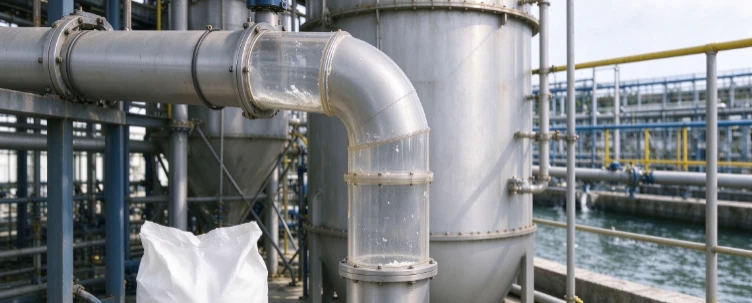
II. Superimposed Risks of Chemical Reactions and Frigid Working Conditions
Soda ash (sodium carbonate, a weak base salt formed from strong base and weak acid) undergoes acid-base neutralization reaction with acid mine drainage. The generated CO₂ gas must be discharged smoothly above the reaction tank or through exhaust pipelines.
Meanwhile, the pneumatic conveying silo must be equipped with reliable silo-top dust removal and venting devices to prevent "air locking" inside the silo caused by conveying air flow, which would lead to powder suspension and unstable feeding. The reaction below illustrates neutralization with sulfuric acid-dominant acidic components; actual AMD systems are accompanied by side reactions of iron, aluminum and heavy metal hydrolysis and precipitation:
Reaction equation: Na₂CO₃ + H₂SO₄ → Na₂SO₄ + CO₂↑ + H₂O
Dew point control of compressed air is critical in northern winter or high-altitude mine sites. If the air compressor is not equipped with a refrigerated dryer, high-temperature and high-humidity compressed air entering the cold silo will condense instantly on the silo wall.
Powder hardening on the silo wall caused by condensation is a hidden hazard of pneumatic conveying systems. In addition, soda ash reacts after solid dissolution. CO₂ bubbles generated in the reaction may wrap around particle surfaces and cause delayed local reaction. Therefore, stirring equipment is still required in the reaction tank to ensure complete neutralization.
III. Incoming Acceptance Inspection
For mine wastewater treatment scenarios, qualified incoming acceptance covers more than checking COA. Three additional tasks are required:
1.Fluidization Test: Simulate on-site air compressor pressure with a glass column in the laboratory and observe the critical fluidization velocity of powder. Reject the batch immediately if fluidization performance is poor.
2.Layered Sampling: Moisture migration easily occurs inside containers or bulk trucks during sea freight (moisture moves from the center to the edges). Collect samples at multiple points and layers during incoming inspection (especially at the bottom and corners) to measure actual moisture distribution.
3.Continuous Pilot Test: Run a continuous pilot test beside the reaction tank and observe the pH rising curve after soda ash dosing. If the pH rises slowly with substantial insoluble residues, poor powder dissolution in the tank is highly likely.
IV. Disclaimer
This article is based on a real on-site engineering failure review, intended as a reference for selection and acceptance for mine environmental engineers. Water quality varies greatly among different mines (especially water with high salinity and high heavy metal content). Formal application must be preceded by pilot tests and beaker experiments according to site conditions.